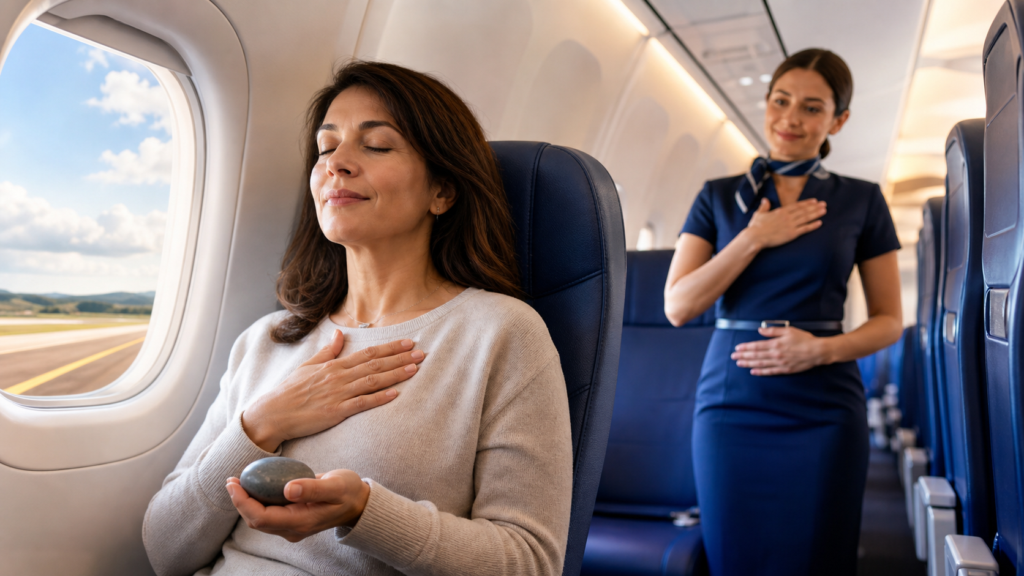
Build an in-flight Coping Plan You Trust
Flying with anxiety can make a simple trip feel huge. Your heart races days before the flight, your mind runs through every worst-case scene, and by the time you sit at the gate you are already exhausted. A written, step-by-step coping plan gives your brain something solid to hold on to instead of spinning in “what if” thoughts.
At Flying Phobia Therapy in New York City, we work with people who are tired of being told they have to “face their fear” by taking practice flights or doing panic drills. Modern non-exposure therapy for phobias takes a different path. Methods like our Total Reset Method aim to shift the root fear pattern first, often in just one to three sessions, so you are not stuck relying only on white-knuckle coping.
In this article, we will walk through a clear, time-based plan you can use before takeoff, during turbulence, and at landing. You will also see how to pair these tools with professional support so trips for work, family, or fun feel possible again, instead of impossible.
Before Takeoff Calm Plan
A good flight starts on the ground. Some anxiety before a flight is normal, even for people who fly often. Your nervous system is noticing that you are doing something out of your usual routine. That does not mean you are in danger.
A few quick mindset resets you can use:
- “Feeling anxious does not mean the plane is unsafe; it means my body is trying to protect me.”
- “Right now I am in a chair, on the ground, and I am safe in this moment.”
- “My thoughts are showing me scary stories, not facts.”
You do not need to replay past rough flights to prepare. Instead, keep your focus on this exact trip and what is true right now.
In the terminal and during boarding, use simple body-based tools that do not push you into panic on purpose:
- Paced breathing: inhale through your nose for 4 counts, exhale through your mouth for 6 counts, repeat for 2 minutes.
- Grounding with senses: quietly name 5 things you can see, 4 things you can feel, 3 things you can hear, 2 things you can smell, 1 thing you can taste.
- A short script on your phone to read, such as: “Planes are designed for this. My body can feel anxious and I can still board, sit, and breathe.”
Logistics also matter, especially in busy travel seasons. When you can, plan for:
- Flight times when you usually feel more relaxed or awake.
- Seat choices that feel comfortable for you.
- A playlist of calming music or familiar podcasts already downloaded.
- Light meals and careful caffeine use so your body is not already jittery.
Pull this together into a one-page plan: pre-flight thoughts, breathing steps, grounding tools, and your logistics list. Fold it into your passport or wallet so you know exactly where it is.
Using Non-Exposure Tools During Turbulence
Turbulence is one of the biggest triggers for flying fear. Your body feels the bumps and instantly thinks, “We are falling.” In reality, turbulence is the plane moving through slightly rough air, like a car on a bumpy road. The aircraft is built for it, and pilots expect it.
Try shifting your language around turbulence:
- Instead of “We are dropping,” use “We are moving through uneven air.”
- Instead of “The plane is out of control,” use “The plane is adjusting to the air; this is what it is designed to do.”
- Instead of “This means we are in danger,” use “This means the air is active, not that something is wrong.”
When bumps start, you can use a simple in-seat routine:
- Breathing: Place one hand on your belly, breathe in for 4, out for 6, for ten cycles.
- Muscle release: Gently tense your feet for 3 seconds, then release. Repeat up your body, calves, thighs, hands, shoulders, and jaw.
- Focus: Press your back into the seat, feel the solid support. Notice the armrests under your hands and the weight of your body in the chair. Quietly name small neutral details, like the color of the seat fabric or the shape of the window.
None of this is “forcing” you to face fear; it is helping your nervous system calm down in real time. When people work with The Total Reset non-exposure therapy for phobias ahead of time, the fear response itself often becomes softer.
Staying Steady Through Descent and Landing
For many anxious flyers, descent feels worse than takeoff. The engine sounds change, your ears pop, and the plane may bank to line up with the runway. Your brain can confuse those shifts with danger.
Simple explanations can help:
- Engine noise often lowers because the plane needs less power as it goes down, not because something failed.
- Ear popping is your body adjusting to air pressure changes.
- Banking turns help the plane follow a safe, planned path to the runway.
Keep a short note on your phone with these reminders so you can reread them if your mind starts racing.
Create a “landing ritual” you repeat on every flight:
- During initial descent, do 10 cycles of your 4-in, 6-out breath.
- As the plane lines up to land, picture yourself walking through the airport, rolling your bag, and stepping outside.
- After the wheels touch down and the plane slows, take a quiet moment to say, “I did it. My anxiety showed up and I still flew.”
End-of-flight triggers are also common:
- Claustrophobia while waiting to disembark: stay seated if you can, keep breathing, and focus your eyes on one calm spot.
- Loud cabin sounds: use earplugs or headphones, and quietly remind yourself, “These are normal airport sounds.”
- Delays on the tarmac: remind yourself that delays are usually about traffic flow or gate availability, not danger, and return to your grounding list.
You can add these “if-then” ideas to your plan, like, “If we wait on the runway, I will start my muscle release sequence again.”
When a Coping Plan Is Not Enough
Sometimes, no matter how many tricks you try, flying still feels unbearable. You might notice that you:
- Cancel or avoid trips that matter to you.
- Say no to work chances that require flights.
- Lose sleep weeks before a planned trip.
- Spend the whole flight gripping the armrests, even with apps or medications.
When that happens, it is not a sign of weakness. It is a sign that your fear lives deeper in your nervous system and needs a more direct reset.
Modern non-exposure therapy for phobias focuses on changing the root fear pattern, not just teaching you how to “get through” panic. At Flying Phobia Therapy, we use the Total Reset Method, a non-exposure process that often works in one to three sessions and usually does not require going into every detail of upsetting flight memories. The goal is for your brain and body to finally update to the present, so planes do not automatically equal danger.
Once that deeper work is done, your in-flight coping plan shifts from being your only lifeline to being a gentle backup. You still breathe, ground, and use your ritual, but from a calmer baseline. Trips in busy seasons or last-minute flights feel far more routine.
Turn Your Next Flight Into a Test Flight for Freedom
You do not have to fix your fear of flying all at once. For now, pick one upcoming trip and decide that flight will be your “test flight” for this plan. From check-in to landing, follow your steps: mindset resets at the gate, breathing and grounding during boarding, your turbulence routine, and your landing ritual.
Print or save a one-page version so it is easy to find. If you are looking for a structured way to outline these steps, ourTen-Step Flight Anxiety CBT Worksheet offers additional practical tips and strategies you can take on board. If, even with this plan, your fear feels stuck or extreme, that is good information that you may need deeper support, like the work we do at Flying Phobia Therapy with the Total Reset Method.
On the other side of flying anxiety is a life where travel is just a normal part of your week, not a looming threat. You can say yes to last-minute visits, show up for people you love, and book trips for fun instead of dread, knowing you have both a calmer nervous system and a clear, proven plan in your back pocket.
Take the First Step Toward Fear-Free Flying
If you are ready to stop letting flight anxiety control your life, we are here to guide you with our specialized non-exposure therapy for phobias. At Flying Phobia Therapy, we use evidence-based methods that help you retrain your mind without forcing you into distressing in-person exposure. Reach out through our contact page today so we can explore the right next step together.